
Wireless UART communication
Transfer ASCII or HEX data between two UART TTL endpoints without a signal cable.

Typical applications
Use the module where two endpoints exchange serial data and the system can operate with half-duplex, request-response communication.
Transfer ASCII or HEX data between two UART TTL endpoints without a signal cable.
Return sampled device data to a nearby controller over a short-range wireless link.
Exchange command and response data for industrial control, remote-control, or robot-control products.
Add a compact SMD wireless link to smart-home appliances and other embedded equipment.
System operation
Modules at both ends must use matching Net ID, RF channel, UART baud rate, and other communication parameters.

Link behavior: The module automatically switches between transmit and receive. Use master-slave polling, request-response, or another mechanism that prevents simultaneous bidirectional transmission.
Application boundaries
The module simplifies short-range embedded links, but final performance depends on the complete product and installation.
✓ Both endpoints use compatible UART TTL logic.
✓ The application supports half-duplex exchange.
✓ Both ends can share matching Net ID, RF channel, and UART settings.
✓ The finished enclosure can be tested.
! Do not connect 5 V UART logic directly.
! Confirm power-supply stability at the module pins.
! Keep the integrated antenna area clear.
! Open-space range is not installed-system range.
* Range condition: Approx. 50 m is a reference value for open line-of-sight conditions. Actual distance depends on the antenna, power supply, enclosure, installation, and interference.
Technical specifications
The released datasheet remains the authority for final circuit and PCB decisions.
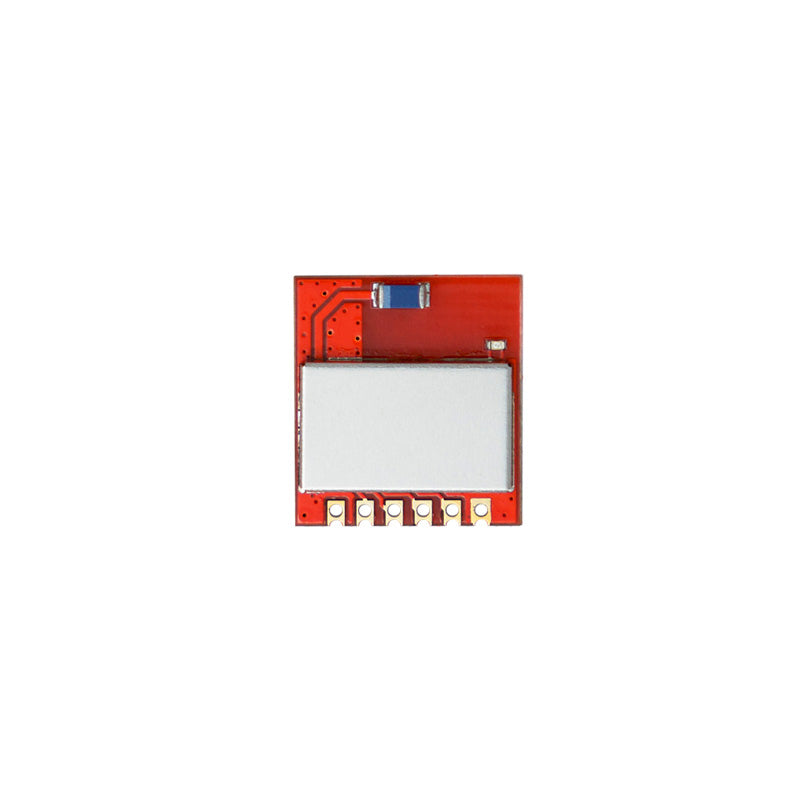
Pin assignment
Operating modes
After configuration, drive SET high and wait about 0.5 s before communication testing.
Sample evaluation
Separate serial, radio and enclosure effects so the team can diagnose the correct layer.
Use two modules and a UART DEMO tool with factory-default parameters.
Cross TXD/RXD, share GND, keep CS low, and keep SET high or floating.
Confirm Net ID, RF channel, and UART baud rate at both ends.
Begin with short packets, then test the application protocol, enclosure, installation, and power supply.
Technical downloads
Datasheets, PCB files and configuration tools appear here when released.
Yes. Default power-on parameters can be used directly for a two-module communication test when the circuit is connected correctly.
Net ID, RF channel, UART baud rate, and the other communication parameters must match.
No. It is the RF air data rate. UART baud rate is a separate setting and defaults to 9600 bps.
No. Confirm logic-level compatibility against the module supply voltage and evaluate level shifting for a 5 V host.
No. The wireless link is half-duplex. Use polling or request-response to avoid simultaneous bidirectional transmission.
It is an approximate open-line-of-sight reference, not a guaranteed installed-system distance.
Purchase options
Module
SKU: Ling-TR5mini-T_V3.0_S3.01 · Stock: 5,000
Online purchase quantity: 100–5,000 modules. Request a quote for 5,001 or more.
Development kit
US$69 / set
SKU: SET-TR5mini-T · Stock: 100 sets
Volume order
Send the target quantity, delivery location and schedule for a bulk quotation.
Request bulk quote →The US$1.45 unit price is applied automatically in the cart for module quantities from 1,001 to 5,000. Quantities of 5,001 or more are quotation only.
MODULE SELECTION SUPPORT
Send us your voltage, frequency, interface and required range.
We will recommend a suitable model within 1 business day.
ENGINEERING GUIDES
Practical guidance for frequency, interface, antenna and final-product validation.