
Lighting & smart home
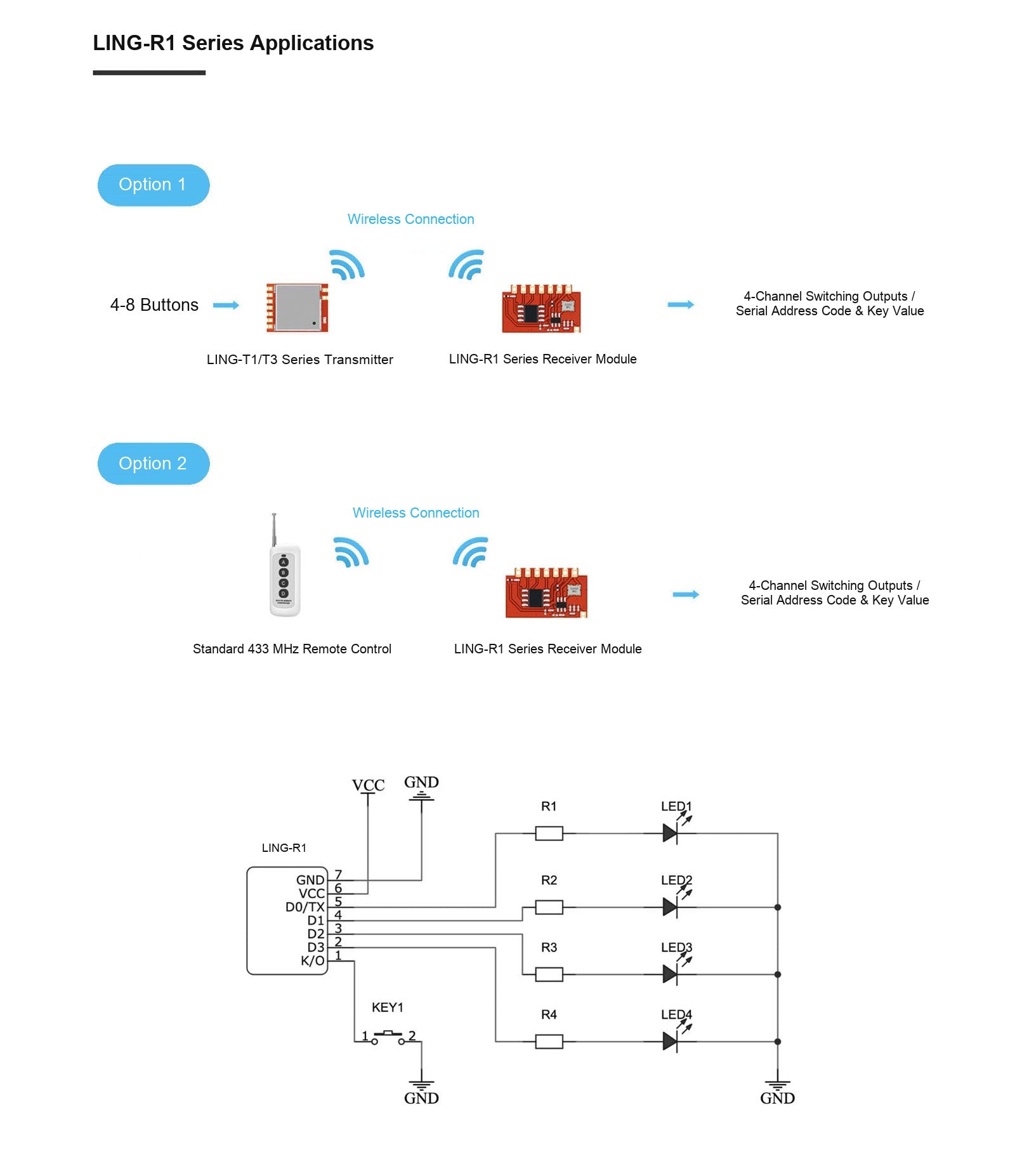
Learnable four-channel outputs for remote-controlled switching.

Typical applications
Use Ling-R1PRO for learnable remote-control reception in lighting, smart-home, door, toy and alarm products. Validate the finished installation.
Learnable four-channel outputs for remote-controlled switching.
Selectable output behavior for motor and door-control systems.
ASK/OOK reception with stored learned remote controls.
Decoded output supports remote-control product testing.
Operating modes
M1, M3, M5 and M5N are the first online models. The datasheet defines further M4 and no-pairing variants; confirm availability before ordering.
Toggle: each remote-control press changes the corresponding output state.
Momentary: output is high while the key is pressed. Default version.
D0 provides fixed 9600 bps ASCII decoded serial output.
No-pairing serial version; D0 provides fixed 9600 bps ASCII output.
Interlock and no-pairing variants defined in Datasheet V2.5; confirm availability before ordering.
Selection boundary: M1/M3/M4 use D0–D3 switching outputs. M5/M5N use D0 as the serial output. Confirm the required mode, transmitter, output logic and antenna before purchase.
Technical specifications
Use the released datasheet for final circuit, antenna and complete-product decisions.
Pins & output mapping
Use common ground with the host controller or external circuit. Do not exceed the specified I/O drive capability.
Learning & control
N versions require no learned pairing. The LED lights for about one second after successful pairing.
After power-on, quickly double-press the pairing key. The LED starts flashing.
Activate a key on the compatible transmitter or remote control.
Hold the pairing key for more than eight seconds after power-on, then release it.
Briefly press the pairing key during operation; D0–D3 return low.
Serial output
Serial variants use fixed 9600 bps ASCII plain-text decoded output, not raw hexadecimal byte data.
LC:DAB10893\r\nLC: fixed frame headerIntegration notes
Receiving distance and stability depend on transmitter power, antenna, supply, enclosure, installation position, motor or relay interference and the local co-channel environment.
Use stable VCC supply and decoupling close to the module; add bulk capacitance as required by the load.
Keep the module and antenna away from relay contacts, motors, switch-mode supplies, inductors and long harnesses.
Keep ANT routing short as a 50 Ω RF trace. Separate RF, digital-output and load-drive areas.
Keep copper, batteries, shields, metal enclosures and long harnesses away from the antenna; retest in final structure.
Compliance boundary: Where the completed product requires FCC, CE, SRRC, EMC or similar certification, rely on complete-product testing and formal reports.
Technical downloads
Technical specifications, pins, operating modes, serial format and integration recommendations.
Use compatible ASK/OOK transmitters such as Ling-T1, Ling-T3, Ling-T3A or Ling-T3MAX. Verify the final system on site.
M1, M3, M5 and M5N are the first online models. Contact FNRF for the other variants defined in the datasheet.
M5 and M5N provide fixed 9600 bps ASCII plain-text decoded output on D0.
Up to 80 remote controls can be learned and retained without power. N versions do not require pairing.
Purchase options
Receiver module
M1, M3, M5 and M5N · Stock: 6,000 each
Online purchase quantity: 200–10,000 modules. Request a quote for quantities above 10,000.
Development kit
US$69 / set
SKU: SET-Ling-R1pro_433_V1.2 · Stock: 200 sets
Volume order
Send the target quantity, delivery location and schedule for a quotation.
Request bulk quote →MODULE SELECTION SUPPORT
Send us your voltage, frequency, interface and required range.
We will recommend a suitable model within 1 business day.
ENGINEERING GUIDES
Practical guidance for frequency, interface, antenna and final-product validation.